What is HSCT?
HSCT acts as a cure for MS by either completely (myleoablative) or partially (non myleoblative) wiping out the memory of the body’s immune system. This is achieved by effecting a change of the body’s overall T and B-lymphocyte (antigen binding) collection thus making autoimmunity inactive and consequently causing the body’s immune cells to become “antigen naive”. This results in restoring immune self-tolerance. Ultimately this stops the underlying MS disease activity & progression and is where the “resetting” the immune system phrase is coined. After HSCT is performed the body then has a chance to repair or reconfigure adaption to existing neural damage without the hindrance of ongoing disease activity and progression, often resulting in improvement of existing conditions and ongoing recovery of lost function.
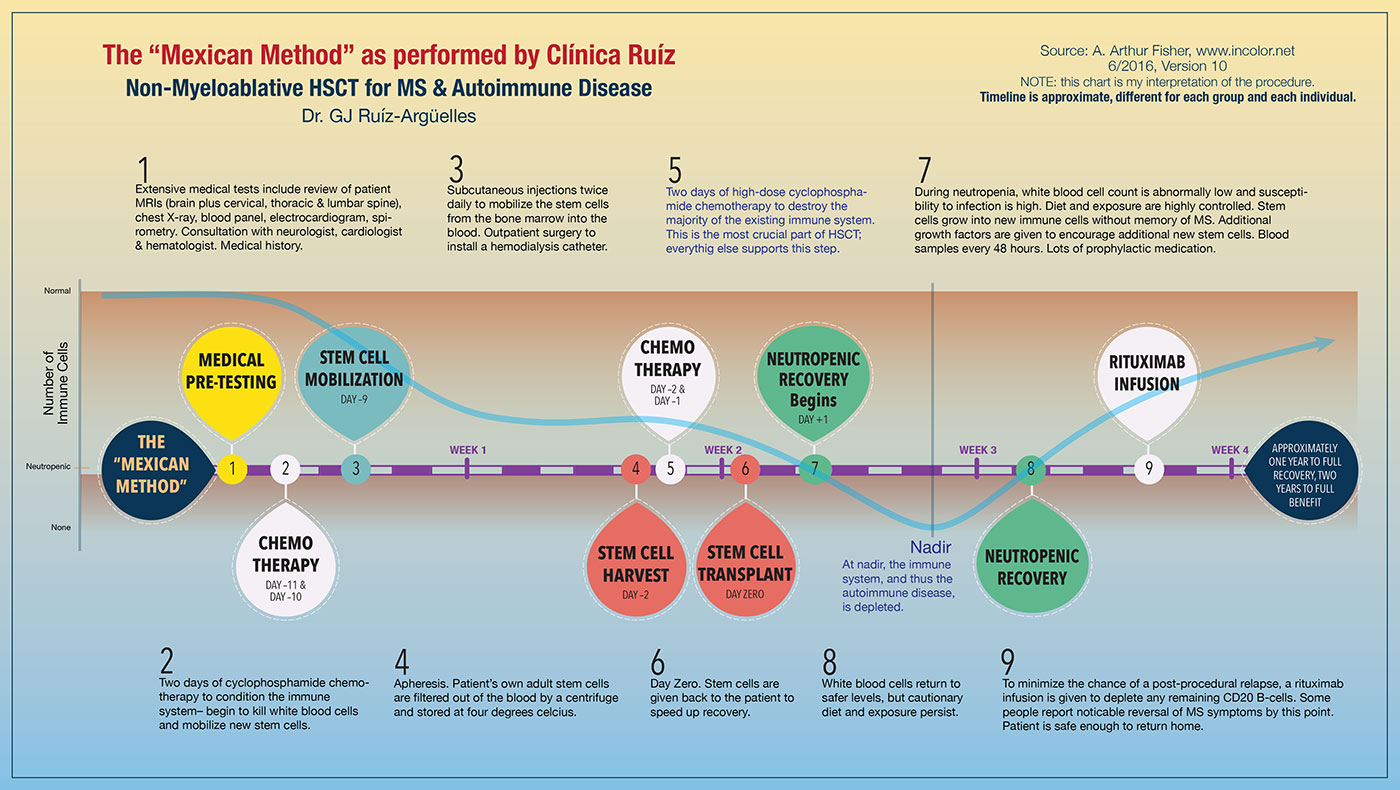
Chemotherapy is used to destroy the T- and B-lymphocytes of the body which carry the faulty memory so that virgin cells which are deprogrammed, may replace them. These are generated by the bone marrow. Successful HSCT is entirely dependent on the chemotherapy aspect of the treatment, which is why simply injecting stem cells into the body does not render the body’s immune system self-tolerant. It is imperative that the chemotherapy destroy the bad cells before the newly harvested virgin cells that have been produced in the bone marrow be reintroduced to the body to get the new immune system firing on all pistons!
STIMULATING PRODUCTION OF STEM CELLS.
Injections are given twice a day for approximately 4 days in order to stimulate production of stem cells. This process, which causes extra stem cells to be produced, is known as mobilization. This is a very straightforward process and mild bone pain if experienced can be alleviated with over-the-counter painkillers.
COLLECTION OF STEM CELLS
Collection of stem cells is a process called “Apheresis”. Some pain in the hip has been reported but in most cases it is a pain free procedure. Blood is withdrawn through a catheter and circulated through a cell-separating machine, which separates and collects white blood cells, including the stem cells. The remaining blood cells are returned to the body at the same rate that they were removed. After collection the cells are frozen and stored under special conditions until they are needed for transplant (reintroduction to the body).
ADMINISTERING CHEMOTHERAPY
Administration of chemotherapy takes four days. This will wipe out the existing immune system. Analysis of the blood will be used to evaluate when the system is adequately prepared in terms of “wipe out” for the stem cell transplantation. Once it has been determined that this has taken place and the body is effectively devoid of its previously malfunctioning immune system, isolation will begin and only attending medical staff will be allowed access to minimize any possibility of germs entering the sterile environment while the immune system is effectively non existent.
PERFORMING THE STEM CELL TRANSPLANT
Once chemotherapy is completed the previously harvested stem cells are returned to the body. It is similar to a blood transfusion. People have commented on symptoms that include nausea, diarrhea, cough fever, chilling and often a headache. Medication is provided to decrease these effects. It is worth remembering the associated discomfort is short lived and the trade off at the end of the day is incomparable in terms of what it offers! The frozen stem cells are thawed in warm water quite simply and infused back into the body.
THE ENGRAFTMENT PART OF THE PROCEDURE
Engraftment is the word given to the process when the harvested stem cells that have been reintroduced to the body begin to grow (engraft). This usually takes between one and three weeks and confirms that the new immune system is now producing blood cells as expected. Aching in the bones, lower back thighs and pelvis has been reported during this phase, but the new immune system will be totally devoid of memory of any MS! Once the new system is back to operating normally the blood count will rise and the white cells in the blood will begin to resume their job, which is to fight off bacteria and prevent infections. Shortly after this happens the hospital releases the patient, but it must be remembered that the immune system will remain compromised for some time. Caution must be observed in terms of exposure to any sort of illness for the next year at least.
THE RECOVERY PHASE
The complete recovery phase is acknowledged as taking twelve to eighteen months. Interestingly in the same way no two people have exactly the same symptoms from MS, recovery works in a similar way. Some people have reported seeing continued improvement long after the procedure. They claim that improvements have taken place as long as 5 years post transplantation. Depending on the type of MS diagnosed prior to receiving treatment, results can vary considerably.
(Copied from hsctstopsms.com)
If you are also interested in beating autoimmune disease with HSCT (effective for many more diseases other than just MS, such as CIDP, Scleroderma, Lupus and many others), I invite you to join our Facebook forum “Hematopoietic Stem Cell Transplant – MS & Autoimmune Disease”
https://www.facebook.com/groups/149103351840242/
 Adios, MS!